December interest rate update
13 December 2024

Key points
- The RBA kept the cash rate at 4.35 per cent following their December meeting.
- Their statement provided no hint of any near-term change in monetary policy, but the tone suggests a rate cut has become more likely.
- I am keeping with my changed view that the first rate cut will be in May.
My view on the timing of the next cash rate change
A few weeks ago, I shifted my view that the first quarter percentage point rate cut in this cycle will take place in May, rather than February. Inflation is coming down. And the economy is sub-par (as highlighted by the Q3 GDP data). But the CPI outcomes have been a little higher than expected. Jobs growth has also been a lot stronger.
The RBA have also given every indication that they’re not in a hurry to ease monetary policy any time soon. The first major piece test for a rate cut is the Q4 CPI data, released on 29 January. Below is a scenario table of my view on the cash rate outlook for 2025.
November RBA meeting outcome
The RBA’s decision to keep the cash rate at 4.35 per cent in November was unsurprising. In their accompanying statement, they noted that confidence on returning inflation to its target has increased, and that the economic data has surprised on the weak side since the last meeting. Those statements suggest that we are getting close to a rate cut. But the RBA still thinks there is excess demand, highlighting various capacity measures, such as the unemployment and participation rates.
The statement is still primarily focused on getting inflation back to target, but noting that good progress has been made in achieving that goal. There is less emphasis on the possibility of a rate hike and a greater nod towards the next move being down.
But the statement does not give the impression a rate cut is imminent. That is understandable given the current ‘underlying’ inflation rate is around 3.5 per cent. But if the Q4 data suggests that inflation is closer to 3 per cent, then I suspect we will see a bigger shift in tone by the RBA at their February meeting.
So what has changed since the last meeting?
Real household disposable income growth – the main reason for domestic economic weakness – has turned positive. A fair chunk of that extra income is currently being saved, although there are signs of some uptick in spending. The ‘underlying’ inflation number in the monthly October CPI data was a little high. This is despite the fact both business and consumer inflation expectations have returned to a level consistent with the 2-3 per cent inflation target. Consumer sentiment is picking up although business sentiment has softened.
The US inflation numbers have picked up a little at the same time as the US economy continues to perform strongly. The Chinese economic data has had a rosier tinge although the news out of Europe has been less promising.
The Q3 GDP data were very weak. The wages data was well under expectations and is already consistent with the inflation target. The October jobs data was less than expected, although that has been after a string of strong monthly job gains. Nationwide house price growth is slowing, but remains elevated in some cities such as Brisbane, Adelaide, and Perth.
Model and consensus views
Financial-market economists were unanimous that there would be no rate cut at the December meeting. An unchanged cash rate is now also the consensus call for Q1 2025, with the majority expecting the first rate reduction to take place in the June quarter. A cash rate of 3.6 per cent is the consensus call for the end of next year, with a broadly similar percentage expecting the rate level to be a quarter percentage point lower or higher.
On the release of the RBA decision, short-term bond yields and the $AUD fell, indicating that financial markets had become more confident about a rate cut within the foreseeable future. After the meeting, financial markets had priced in the first move by April, half a percentage point of rate cuts by July, and an additional quarter percentage point before year-end.
My monetary policy model does suggest that there should have been a rate cut at the December meeting. It also suggests that the cash rate should be 3.6 per cent by end-2025 (with the risk it could be lower).
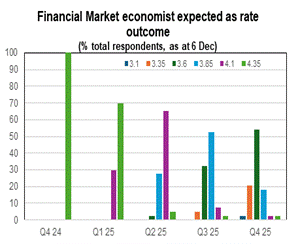
Financial market rate predictions from economists
The consensus is that the first rate cut will be in Q2, 2025.
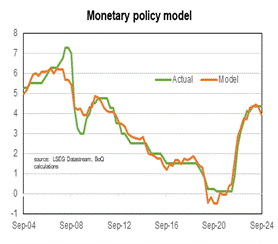
Peter Munckton's monetary policy model
My model suggests that the cash rate should have already been reduced by now.
We really do live in interesting times.
Regards,
Peter Munckton
BOQ Chief Economist.
You might also like
NOT INVESTMENT RESEARCH
This presentation was prepared by Bank of Queensland Limited ABN 32 009 656 740 Australian Credit Licence Number 244616 (Bank).
No Reliance
This presentation is not investment research and does not purport to make any recommendations. This report is for informational purposes only and is not to be relied upon for investment purposes. You should seek independent advice from a qualified professional on these matters.
This presentation has been prepared without considering your objectives, financial situation, knowledge, experience or needs. The content of this presentation is not to be construed as an act of solicitation, or an offer to buy or sell financial products. To the extent that you choose to make any investment decision after having read this report, you should consider the appropriateness and suitability to your own objectives and obtain independent professional advice about your particular circumstances.
The Bank makes no representations or warranties about the accuracy or completeness of the content contained in this presentation. Any opinions, conclusions or recommendations made in this report are subject to change without notice, and may differ to the opinions, conclusions or recommendation expressed elsewhere by the Bank. The Bank is under no obligation to update, keep current, the information contained in the report.
Forward-Looking Statements
This presentation may contain forward-looking statements about market conditions. These forward-looking statements may be identified using forward-looking terminology, including the terms “believe”, “estimate”, “plan”, “target”, “project”, “anticipate”, “expect”, “intend”, “likely”, “may”, “will”, “could” or “should” or, in each case, their negative or other variations or other similar expressions, or by discussions of future events.
Readers should not place undue reliance on any forward-looking statements. To the maximum extent permitted by law, responsibility for the accuracy or completeness of any forward-looking statements, whether because of new information, future events, or results or otherwise, is disclaimed. BOQ does not undertake to update any forward-looking statements contained in this document, subject to disclosure requirements applicable to it.
Liability
The Bank does not accept any liability for any loss or damage arising out of any error or omission in the information provided or arising out of the use of all or any part of this presentation.