Latest Alerts
Learn about the latest scams and fraudulent activities, so you can keep up to date with scams that may target you. {sub-heading}

If in doubt, contact BOQ {yellow-border}
To report a fraud or scam, visit your local branch or call us immediately.


BOQ Impersonation scam {yellow-border}
October 2026
We’re seeing a rise in bank impersonation scams, where customers are receiving calls from someone claiming to be from the BOQ Bank Fraud Team or BOQ Bank Head Office.
The caller introduces themselves as ‘Peter Steel’ and claims there has been:
- A suspicious transaction,
- A suspicious sign-in on your account, or
- A reference to a recent card compromise and an offer to help.
Customers may also receive SMS messages that appear to reference fraud investigations, account activity or card compromises to make the scam appear legitimate before receiving a follow-up phone call.
Scammers will then ask you to provide card details, the One-Time-Pin (OTP) sent to your phone or sensitive personal information such as the codes to your banking app.
How to Identify and Avoid Bank Impersonation Scams:
- Unexpected Contact: Be cautious of all calls claiming to be from BOQ or other banks.
- Identification Questions: Scammers will try to obtain your identification information, card details, OTP sent to your phone, and the answers to your security questions. They may use scare tactics if you refuse to answer.
- Check the Source: If unsure about the authenticity of a call, hang up and contact BOQ directly using the public number on our website.
If You Suspect a Bank Impersonation:
-
Do Not Engage: If you receive an unsolicited email or phone call, do not click on any links or provide any identification information or OTPs.
-
Stay Calm: Scammers may use scare tactics to get you to engage, such as claiming there has been a large unauthorised transaction or a suspicious sign-in on your account.
- Always contact BOQ through official channels so the fraud team can assess your accounts.
-
Report It: Contact BOQ to report the incident. We can provide further advice and support to help you avoid the scam and protect yourself.
If in doubt, contact BOQ:
To report a fraud or scam, call us immediately on 1300 55 72 72, 24 hours, 7 days a week. Or attend your local branch for in-person support.
If you have any concerns about the legitimacy of correspondence, or individuals, you can contact BOQ directly (either via fraudandscamoperations@boq.com.au or using the details on our Report a Fraud or Scam page).
Report a cybercrime or cyber security incident to the ACSC via Report Cyber at www.cyber.gov.au/report or call the Australian Cyber Security Hotline on 1300 CYBER! (1300 292 371).
For more tips and resources, visit: https://www.boq.com.au/personal/help-and-support/fraud-and-scams/report
BOQ Impersonation scam {yellow-border}
July 2026
We’re seeing a rise in bank impersonation scams, where customers are receiving calls from someone claiming to be from the BOQ Bank Fraud Team or BOQ Bank Head Office.
The caller introduces themself and claims there has been:
- A suspicious transaction,
- A suspicious sign in on your account, or
- A reference to a recent card compromise and an offer to help.
Scammers will then ask you to provide card details, the One-Time-Pin (OTP) sent to your phone or sensitive personal information such as the codes to your banking app.
How to Identify and Avoid Bank Impersonation Scams:
- Unexpected Contact: Be cautious of all calls claiming to be from BOQ or other banks.
- Identification Questions: Scammers will try to obtain your identification information, card details, OTP sent to your phone, and the answers to your security questions. They may use scare tactics if you refuse to answer.
- Check the Source: If unsure about the authenticity of a call, hang up and contact BOQ directly using the public number on our website.
If You Suspect a Bank Impersonation:
- Do Not Engage: If you receive an unsolicited email or phone call, do not click on any links or provide any identification information or OTPs.
- Stay Calm: Scammers may use scare tactics to get you to engage, such as claiming there has been a large unauthorised transaction or a suspicious sign-in on your account. Always contact BOQ through official channels so the fraud team can assess your accounts.
- Report It: Contact BOQ to report the incident. We can provide further advice and support to help you avoid the scam and protect yourself.
If in doubt, contact BOQ:
To report a fraud or scam, call us immediately on 1300 55 72 72 , 24 hours, 7 days a week. Or attend your local branch for in-person support.
If you have any concerns about the legitimacy of correspondence, or individuals, you can contact BOQ directly (either via fraudandscamoperations@boq.com.au or using the details on our Report a Fraud or Scam page).
Report a cybercrime or cyber security incident to the ACSC via Report Cyber at www.cyber.gov.au/report {external-link}, or call the Australian Cyber Security Hotline on 1300 CYBER! (1300 292 371).
For more tips and resources, visit: https://www.boq.com.au/personal/help-and-support/fraud-and-scams/report
BOQ and myBOQ branded phishing scams{yellow-border}
July 2026
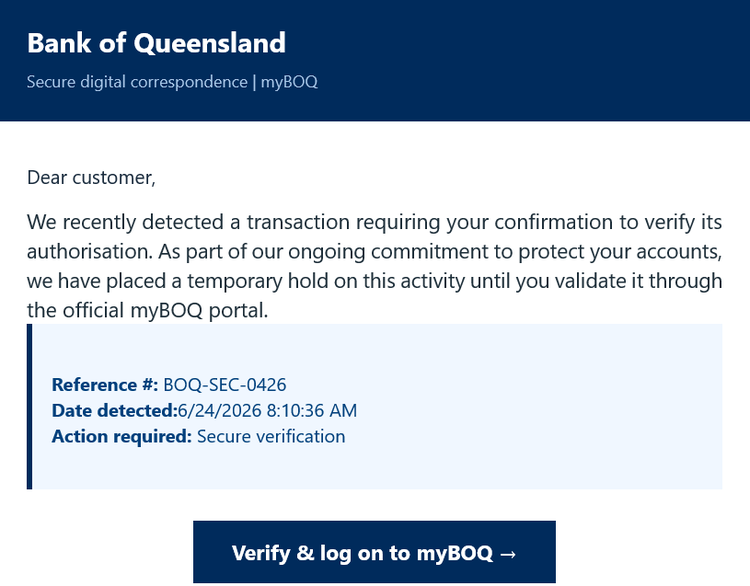
BOQ Group is warning customers about an increase in BOQ and myBOQ branded phishing scams. These scams often come in the form of emails or SMS designed to trick you into providing sensitive information.
The latest myBOQ email requests customers to:
- Confirm a recent “detected transaction” to verify its authorisation
- Open an attached document and clink a link to review transactions.
These messages are not legitimate and should be deleted immediately.
The latest BOQ email requests customers to:
- Verify a recent detected transaction.
- Contains a "Verify & log on to myBOQ" link.
- Claims account activity is on hold.
- Gives a fake reference number.
It is crucial to stay vigilant and be aware of the signs of these fraudulent attempts.
How to protect yourself from phishing scams:
- Don't click on any unexpected emails or SMS.
- Only use trusted applications and websites for banking.
- Never provide remote access to your device or PC.
[br]
If in doubt, contact BOQ:
To report a fraud or scam, attend your local branch or call us immediately on 1300 55 72 72 (Monday-Friday, 8am-8pm AEST, and Saturday 9am-5pm AEST).
If you have any concerns about the legitimacy of correspondence, or individuals, you can contact BOQ group directly.
Report a cybercrime or cyber security incident to the ACSC via ReportCyber at www.cyber.gov.au/report<http://www.cyber.gov.au/report>, or call the Australian Cyber Security Hotline on 1300 CYBER! (1300 292 371).
For more tips and resources, visit: https://www.boq.com.au/help-and-support/fraud-and-scams
BOQ Spoofed Number{yellow-border}
March 2026
Scammers have spoofed BOQ’s genuine number (07) 3212 3333 and are attempting to call BOQ customers to conduct a scam.
The scammers claim to be from BOQ and claim that suspicious activity is occurring on the customers’ accounts.
If the scam call proceeds, the scammer will request sensitive personal or banking information, such as CAN’s, Card numbers, security questions or OTP’s.
How to Identify and Avoid BOQ Impersonation Scam:
Please be extra cautious for phone calls that seem suspicious:
- Suspicious phone call: Caller impersonating BOQ and may call from (07) 3212 3333.
- Suspicious Links: Malicious links requesting you to access a fraudulent website.
- Urgent Requests: Caller pressures you to act quickly or provide confidential information.
If You Suspect a BOQ Impersonation Scam:
- Do Not Engage: If you or a customer receives an unsolicited call or SMS, do not to click on any links or provide any identification information or OTPs.
- Stay Calm: Scammers may use scare tactics to get you or a customer to engage. Always contact BOQ through official channels so the fraud team can assess impacted accounts.
- Report It: Contact BOQ to report the incident. We can provide further advice and support to help avoid the scam and protect ourselves.
If in doubt, contact BOQ:
To report a fraud or scam, attend your local branch or call us immediately on 1300 55 72 72, 24 hours/day, 7 days a week.
If you have any concerns about the legitimacy of correspondence, or individuals, you can contact BOQ group directly https://www.boq.com.au/help-and-support/fraud-and-scams/report.
Report a cybercrime or cyber security incident to the ACSC via Report Cyber at www.cyber.gov.au/report, or call the Australian Cyber Security Hotline on 1300 CYBER! (1300 292 371).
For more tips and resources, visit: https://www.boq.com.au/help-and-support/fraud-and-scams
BOQ Rewards Impersonation & Phishing Scam {yellow-border}
March 2026
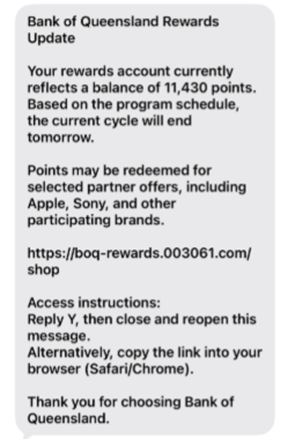
BOQ Group is warning customers about an increase in bank impersonation scams. Customers have reported impersonators of BOQ through SMS messages using BOQ branding.
The messages are branded as a Bank of Queensland Rewards Update and claims your rewards points balance is about to expire.
The SMS references popular retailers such as Apple and Sony and prompts recipients to urgently reply to the message or access a suspicious link. The link may direct you to a fraudulent website designed to capture personal or banking information.
How to Identify and Avoid Support Impersonation Scams:
- Suspicious Message: BOQ branded SMS message receive from unknown numbers.
- Suspicious Links: Malicious links requesting you to access a fraudulent website.
- Urgent Requests: Caller pressures you to act quickly or provide confidential information.
[br]
If You Suspect a BOQ Security Impersonation:
- Do Not Engage: If you receive an unsolicited SMS message, do not click on any links or provide any identification information or OTPs.
- Stay Calm: Scammers may use scare tactics to get you or a customer to engage, such as claiming rewards points are expiring and requesting immediate action to redeem. Always contact BOQ through official channels so the fraud team can assess your accounts.
- Report It: Contact BOQ to report the incident. We can provide further advice and support to help you avoid the scam and protect yourself.
If in doubt, contact BOQ:
To report a fraud or scam, attend your local branch or call us immediately on 1300 55 72 72, 24 hours/day, 7 days a week.
If you have any concerns about the legitimacy of correspondence, or individuals, you can contact BOQ group directly https://www.boq.com.au/help-and-support/fraud-and-scams/report.
Report a cybercrime or cyber security incident to the ACSC via Report Cyber at www.cyber.gov.au/report, or call the Australian Cyber Security Hotline on 1300 CYBER! (1300 292 371).
For more tips and resources, visit: https://www.boq.com.au/help-and-support/fraud-and-scams
Footy Season Ticket Scam{yellow-border}
March 2026
Football season is about to kick off for the year and BOQ Group is reminding customers to stay alert for ticket scams, particularly “goods not received” scams involving fake tickets.
Scammers often advertise tickets for sold-out or high-demand games on social media pages like Facebook Marketplace, including in the comment sections. They may pressure you to pay quickly and then disappear once you’ve transferred the money.
Last year, Criminals Australians lost more than $36 million to this type of scam.
How to spot and avoid ticket scams
Buy only from official sources
- The best way to avoid fake tickets is to purchase through authorised ticket sellers listed on the official club, stadium, or competition website.
- Be cautious of look-alike websites and always check you’re on the legitimate ticket portal (not a third-party copycat site).
Be wary of social media ticket offers
Scammers may:
- Pretend to be a genuine seller
- Use compromised accounts (including accounts that look like friends or community members)
- Contact people directly who post that they’re looking for tickets
Look out for common red flags
- Tickets are heavily discounted or “too good to be true”
- Seller profile is new, has no history, or very few friends/followers
- Vague details, refusal to provide proof, or excuses to avoid meeting/verification
- Pressure to pay immediately e.g.“someone else is about to buy them”.
Avoid risky payment methods
Be extra cautious if asked to pay via:
- Bank transfer
- Cryptocurrency
- PayPal Friends & Family
- Gift cards
Use safer payment options
If you choose to buy second-hand, use payment methods with buyer protection (where possible), and avoid paying outside secure platforms.
[br]
If you think it’s a scam
- Do not proceed with payment
- Report it to Scamwatch: https://www.scamwatch.gov.au/
- Report the listing to the platform (e.g., Facebook Marketplace)
- For Australian consumer scam reports, you can also report via the ACCC/Scamwatch channels above
If in doubt, contact BOQ
To report a fraud or scam, attend your local branch or call us immediately on 1300 55 72 72, 24 hours/day, 7 days a week.
If you have any concerns about the legitimacy of correspondence, or individuals, you can contact BOQ group directly https://www.boq.com.au/help-and-support/fraud-and-scams/report
Report a cybercrime or cyber security incident to the ACSC via Report Cyber at www.cyber.gov.au/report or call the Australian Cyber Security Hotline on 1300 CYBER! (1300 292 371).
For more tips and resources, visit: https://www.boq.com.au/help-and-support/fraud-and-scams
myBOQ Security Impersonation & Phishing Scam {yellow-border}
March 2026
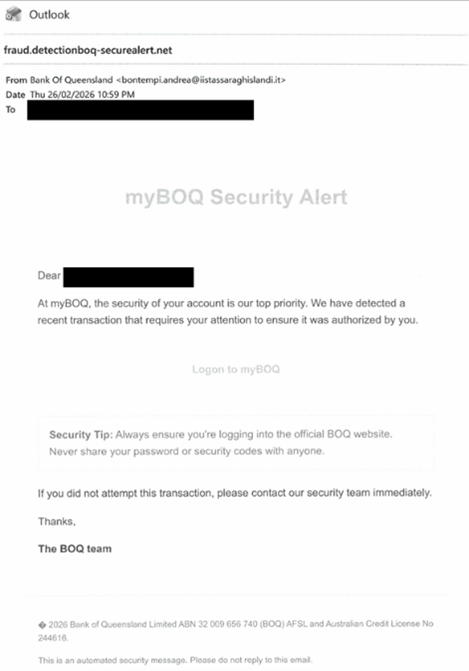
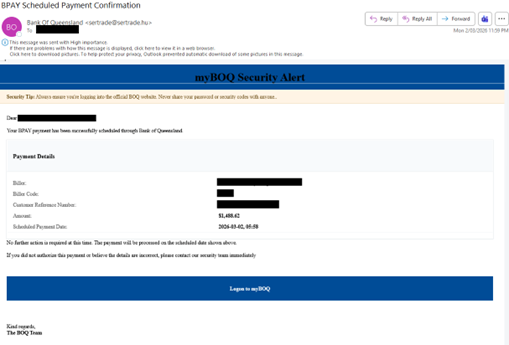
BOQ Group is warning customers about an increase in bank impersonation scams. Customers have reported impersonators of myBOQ Security through emails using BOQ branding. The emails claim that a transaction requires your attention and requests you to login to your myBOQ profile via a fraudulent link.
Clicking this link prompts you to enter your CIF and Access Code. Once this is completed, the scammers can attempt to log into your bank account and attempt to transfer funds.
How to Identify and Avoid Support Impersonation Scams
- Suspicious Email: myBOQ branded emails sent from ‘bontempi.andrea@iistassaraghislandi.it’, ‘hantd21mba@uef.edu.v’ and ‘sertrade@sertrade.hu’.
- Suspicious Links: Malicious links requesting you to login to your myBOQ profile.
[br]
- Unexpected Calls: Follow up scam calls where the caller claims to be from myBOQ Security or BOQ.
- Attempts to Collect Personal Information: Scammers may ask for identification details, card numbers, one-time passwords (OTPs), or answers to security questions. They often use scare tactics, such as claiming there’s an unauthorised transaction or suspicious activity on your account.
- Check the Source: Contact BOQ directly through https://www.boq.com.au/contact-us
If You Suspect a BOQ Security Impersonation
- Do Not Engage: If you receive an unsolicited email or phone call, do not click on any links or provide any identification information or OTPs.
- Stay Calm: Scammers may use scare tactics to get you to engage, such as claiming there has been a large unauthorised transaction or a suspicious sign-in on your account. Always contact myBOQ through official channels so the fraud team can assess your accounts.
- Report It: Contact myBOQ to report the incident. We can provide further advice and support to help you avoid the scam and protect yourself.[br]
If in doubt, contact BOQ
To report a fraud or scam, attend your local branch or call us immediately on 1300 55 72 72, 24 hours/day, 7 days a week.
If you have any concerns about the legitimacy of correspondence, or individuals, you can contact BOQ group directly https://www.boq.com.au/help-and-support/fraud-and-scams/report
Report a cybercrime or cyber security incident to the ACSC via Report Cyber at www.cyber.gov.au/reportor call the Australian Cyber Security Hotline on 1300 CYBER! (1300 292 371).
For more tips and resources, visit: https://www.boq.com.au/help-and-support/fraud-and-scams
December 2025 – Social Media Impersonation Scam
BOQ Group is warning customers about an increase in bank impersonation scams. Customers have reported receiving friend request from BOQ-branded Facebook profiles.
How to Identify and Avoid Impersonation Scams
- Unexpected Friend Requests: BOQ will never send friend requests or contact you via Facebook or any other social media platform. If you receive a friend request claiming to be BOQ, do not accept it.
- Attempts to Collect Personal Information: Scammers may ask for identification details, card numbers, one-time passwords (OTPs), or answers to security questions. They often use scare tactics, such as claiming there’s an unauthorised transaction or suspicious activity on your account.
- Check the Source: Contact BOQ directly using the public number or email fraudandscamoperations@boq.com.au.
If You Suspect a Social Media Impersonation
- Do Not Engage: If you receive an unsolicited friend request, do not provide any identification information or OTPs.
- Stay Calm: Scammers may use scare tactics to get you to engage, such as claiming there has been a large unauthorised transaction or a suspicious sign-in on your account. Always contact BOQ through official channels so the fraud team can assess your accounts.
- Report It: Contact BOQ to report the incident. We can provide further advice and support to help you avoid the scam and protect yourself.
If in doubt, contact BOQ
To report a fraud or scam, attend your local BOQ branch or call us immediately on 1300 55 72 72 (Monday-Friday, 8am-8pm AEST, and Saturday 9am-5pm AEST).
If you have any concerns about the legitimacy of correspondence, or individuals, you can contact BOQ group directly (either via fraudandscamoperations@boq.com.au au or using the details on our Contact Us page).
Report a cybercrime or cyber security incident to the ACSC via ReportCyber at www.cyber.gov.au/report, or call the Australian Cyber Security Hotline on 1300 CYBER! (1300 292 371).
For more tips and resources, visit: https://www.boq.com.au/help-and-support/fraud-and-scams.
November 2025 – Online Shopping Scams
As we approach the festive season, it’s important to stay vigilant against scams and fraud. Scammers take advantage of the festive season to imitate genuine brands, websites and services.
Common scams to watch out for this festive season
Online shopping scams
- Scammers take advantage of the festive season to imitate genuine brands, websites and delivery services. Shopping scams remain a significant threat, exposing individuals and businesses to risks through fake product listings, deceptive payment requests, and insecure payment avenues.
- If you receive suspicious emails or messages, refrain from clicking any links or providing card details. Exercise caution with online shopping deals; if it seems too good to be true, it probably is!
Flights and accommodation travel scams
- The rise in online holiday and flight bookings is feeding a spike in travel scams with fake hotel bookings and non-existent flight bargains, costing Australians millions of dollars. Avoid scams this summer by booking with a hotel or airline directly. Or confirm the website you use is legitimate by checking that the website’s ABN is actually registered to the named trader – you can do this for free through the Australian Business Register’s ABN Lookup portal.
Parcel delivery scams
- At this time of year, millions of gifts are sent and received, and scammers make money from fake parcel delivery services.
- Usually, you get an email or text seemingly from Australia Post or another well-known delivery service. It will say your package couldn’t be delivered and request you click on a link and give personal details for re-delivery.
Charity scams
- It’s the season of giving and scammers prey on people’s generosity. Be wary of emails, texts, or calls asking for money that might look like they’re from well-known charities.
- If you wish to donate to an established charity or not-for-profit organisation, make sure it is registered. You can do this by searching through the Australian Charities and Not-for-profits Commission Charity Register - https://www.acnc.gov.au/charity/programs/map
Tips to protect yourself
- When shopping online, look out for imposter websites imitating legitimate businesses.
- Book directly with hotels and airlines to avoid travel scams.
- Verify the authenticity of any communication you receive. Always contact the organisation directly using official contact details rather than those provided in the suspicious message.
- Safeguard your payment information by refraining from saving your payment information to the web browser or online accounts.
- Update your passwords and use strong, unique passwords for different accounts. Enable two-factor authentication where possible.
- Watch out for texts or emails relating to parcel deliveries – scammers pose as Australia Post or other delivery partners asking you to pay or provide information before receiving your delivery. Don't click on any links and contact the company directly to confirm.
- Similarly, scammers send texts or emails to solicit fraudulent donations. If you want to give, find the charity's contact details and donate directly.
If in doubt, contact BOQ
To report a fraud or scam, attend your local BOQ branch or call us immediately on 1300 55 72 72 (Monday-Friday, 8am-8pm AEST, and Saturday 9am-5pm AEST).
If you have any concerns about the legitimacy of correspondence, or individuals, you can contact BOQ group directly (either via fraudandscamoperations@boq.com.au au or using the details on our Contact Us page).
Report a cybercrime or cyber security incident to the ACSC via ReportCyber at www.cyber.gov.au/report, or call the Australian Cyber Security Hotline on 1300 CYBER! (1300 292 371).
For more tips and resources, visit: https://www.boq.com.au/help-and-support/fraud-and-scams.
September 2025 – BOQ International Phone Number Spoofing
We are alerting customers to a sophisticated scam involving callers impersonating BOQ Group's BOQ/ME or Virgin Money banks fraud team. Calls have been made to BOQ Group customers that are appearing to come from our international phone number +613 9708 4001. During these calls, it has been reported that the callers have been using famous names such as Jamie Oliver, or Mark Zuckerberg.
How to identify the scam call:
- Scammers are calling under the guise of preventing fraudulent transactions on the account.
- Callers will ask for account sensitive information such as passwords, card numbers, log details and pins under the guise of completing identity verification.
- Scammers may request for you to download remote access software.
- We do not call customers from this international number.
- If we call you, we will never ask you for any one time pins and will never ask you for your full card number.
What to do if you suspect a scam?
- If you’re ever unsure please terminate the call and contact us on 1300 55 72 72 to confirm if the caller is actually an employee.
- If you have provided remote access, please disconnect your device from the internet and contact us on 1300 55 72 72 immediately.
- Block suspect callers and cease any interactions with the caller.
If in doubt, contact BOQ:
To report a fraud or scam, attend your local branch or call us immediately on 1300 55 72 72 (Monday-Friday, 8am-8pm AEST, and Saturday 9am-5pm AEST).
If you have any concerns about the legitimacy of correspondence, or individuals, you can contact BOQ group directly (either via fraudandscamoperations@boq.com.au or using the details on our Contact Us page).
Report a cybercrime or cyber security incident to the ACSC via ReportCyber at www.cyber.gov.au/report, or call the Australian Cyber Security Hotline on 1300 CYBER! (1300 292 371).
For more tips and resources, visit: https://www.boq.com.au/help-and-support/fraud-and-scams.
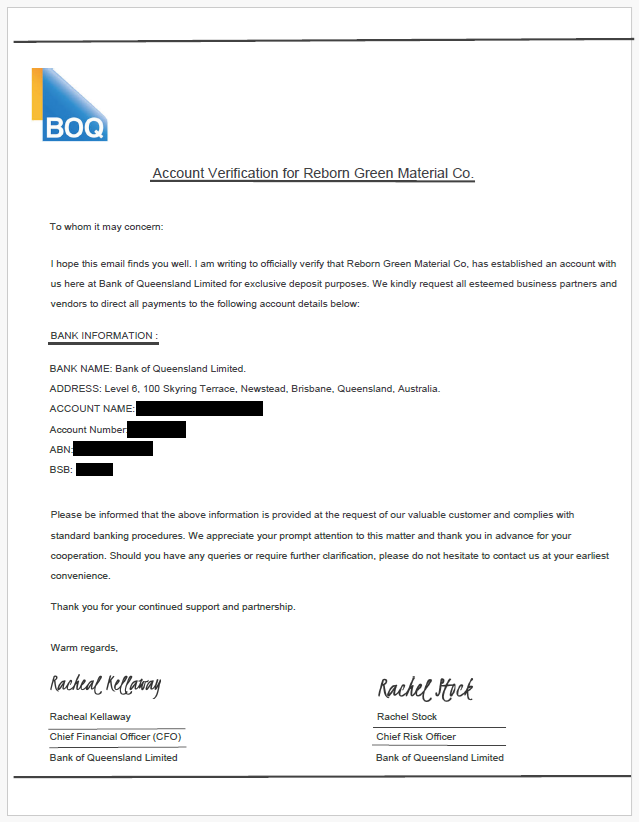
September 2025 – BOQ Group Executive Impersonation Fraud
BOQ Group is warning customers about a scam involving forged documents impersonating senior executives. Customers have reported receiving emails appearing to be from Racheal Kellaway, BOQ’s Chief Financial Officer, and Rachel Stock, BOQ’s Chief Risk Officer. These documents falsely verify accounts and use BOQ branding and forged executive signatures to appear legitimate.
Scammers may use these materials to solicit sensitive information or financial transactions. Engaging with these documents may expose individuals to identity theft, financial loss, or reputational harm.
How to Identify and Avoid Impersonation Scams
- Unexpected Requests: Be wary of unsolicited requests for personal or financial information including account verification, payment details, or sensitive personal information. Never click on a link or disclose sensitive information via email or text message.
- Check the Source: Always verify the authenticity of the communication. Look out for email addresses or contact details that appear slightly altered or unfamiliar. Remember phishing messages can be spoofed to appear to be from a genuine source. If in doubt, contact BOQ or the company via a verified contact line to gain advice.
- Look for Red Flags: Poor grammar, misspelled words, and email addresses that don't match the official domain are common indicators of phishing attempts.
- Messages Using Urgent or Pressuring Language: Scammers often use urgency to prompt immediate action. Be cautious of messages that demand quick responses, threaten consequences, or use emotional manipulation to bypass your usual checks.
- Secure Your Information: Use strong, unique passwords for all your accounts and enable multi-factor authentication where available. Check the security of your email, Linked In and social media accounts. Often these phishing emails occur via information that is accessible or compromised.
- Stay Informed: Educate yourself about the latest scam tactics and share this knowledge with your network.
If You Suspect an Impersonation Scam
- Do Not Respond or Click on Links: If you receive a suspicious email or message, do not click on any links or respond to the sender.
- Report It: Contact BOQ's Customer Contact Centre immediately to report the incident and verify the legitimacy of the communication. You can also report suspected phishing attempts to ScamWatch or the company you believe is being impersonated.
- Protect Your Accounts: Change your passwords regularly and monitor your accounts for any unusual activity.
If in doubt, contact BOQ:
To report a fraud or scam, attend your local branch or call us immediately on 1300 55 72 72 (Monday-Friday, 8am-8pm AEST, and Saturday 9am-5pm AEST).
If you have any concerns about the legitimacy of correspondence, or individuals, you can contact BOQ group directly (either via fraudandscamoperations@boq.com.au or using the details on our Contact Us page).
Report a cybercrime or cyber security incident to the ACSC via ReportCyber at www.cyber.gov.au/report, or call the Australian Cyber Security Hotline on 1300 CYBER! (1300 292 371).
For more tips and resources, visit: https://www.boq.com.au/help-and-support/fraud-and-scams.
August 2025 – Renting and Selling Accounts
BOQ has identified a new trend where customers are encouraged to sell or rent their bank accounts. Once in the hands of the scammers, they will then use your account to move criminal & illegitimately obtained funds between various financial institutions to launder money.
This not only leads to accounts being permanently closed & the debanking of your profiles, but also significant legal consequences for the owner of the now rented bank account.
Sometimes, the renting of your bank account can start as a simple job opportunity promising a consistent flow of money online. After building your trust over several transfers into your account, they will then look to take control of your account & even ask you to start depositing your own money.
The main way victims are targeted for “scambling” are through engaging with unregulated online gambling websites, typically advertised through social media platforms like Facebook.
These platforms encourage the participants to make frequent small transactions allowing for fraudulent funds to be moved in small amounts between multiple financial institutions.
What to look for:
- Be wary of any ads offering funds in return for minimal work
- Do not provide any banking access or personal information to unfamiliar contacts
- Avoid engaging in any online gambling you found through social media
- Any job opportunities that request you send them money to receive any funds
- Be wary of any third parties that are instructing you to create new bank accounts or instructing you on what to do with your funds
How to protect yourself:
- Don’t share banking and personal details with anyone you don’t know or trust
- Do not allow anyone to ‘borrow’ your bank account
- Before engaging in any job opportunities research the legitimacy of the offer and company
- Be cautious of any opportunities offering unrealistic salaries or seem to ‘good to be true’
If in doubt, contact BOQ:
- To report a fraud or scam, attend your local branch or call us immediately on 1300 55 72 72 (Monday-Friday, 8am-8pm AEST, and Saturday 9am-5pm AEST).
- If you have any concerns about the legitimacy of correspondence, or individuals, you can contact BOQ group directly (either via fraudandscamoperations@boq.com.au or using the details on our Contact Us page).
- Report a cybercrime or cyber security incident to the ACSC via ReportCyber at www.cyber.gov.au/report, or call the Australian Cyber Security Hotline on 1300 CYBER! (1300 292 371).
- For more tips and resources, visit: https://www.boq.com.au/help-and-support/fraud-and-scams
Relevant websites - https://www.afp.gov.au/news-centre/media-release/stop-cashing-crooks-australians-urged-not-rent-or-sell-bank-accounts-cash
July 2025 – BOQ Branded Phishing Scam
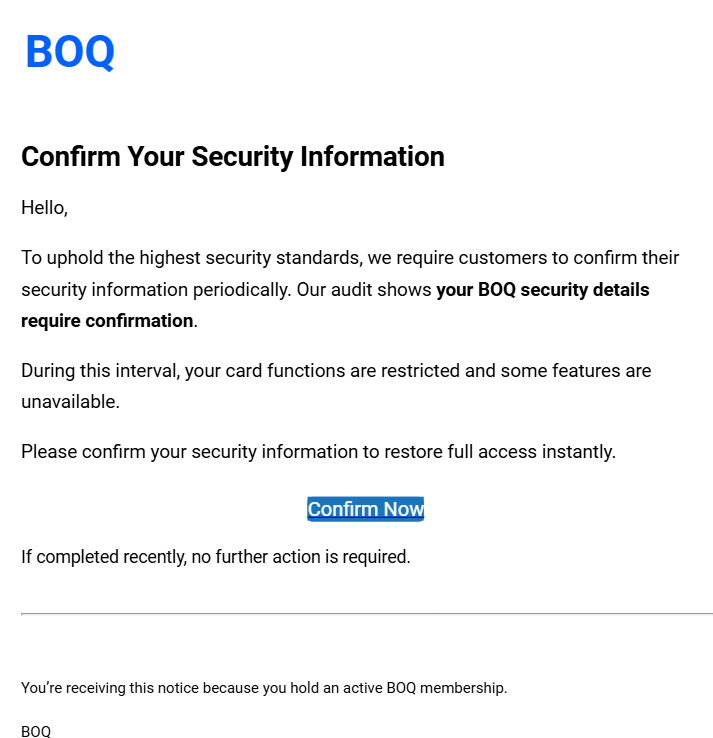
BOQ Group has identified a new phishing scam targeting customers via SMS and email. These fraudulent messages are designed to trick recipients into providing personal and banking information by impersonating BOQ and claiming your BOQ account has been restricted.
It is crucial to stay vigilant and be aware of the signs of these fraudulent attempts.
How to Identify and Avoid Phishing Scams The phishing messages:
- Claim to be from BOQ and request customers to log in to confirm security information, as pictured to the right.
- Include a “Confirm Now” link.
- Threaten card restrictions or account suspension if action is not taken.
These messages are not legitimate and should be deleted immediately.
How to protect yourself from phishing scams:
- Don’t click on any unexpected emails or SMS.
- Only use trusted applications and websites for banking.
- Never provide remote access to your device or PC.
- Do not share your banking credentials, PINs, or verification codes with anyone.
If in doubt, contact BOQ:
To report a fraud or scam, attend your local branch or call us immediately on 1300 55 72 72 (Monday-Friday, 8am-8pm AEST, and Saturday 9am-5pm AEST).
If you have any concerns about the legitimacy of correspondence, or individuals, you can contact BOQ group directly (either via fraudandscamoperations@boq.com.au or using the details on our Contact Us page).
Report a cybercrime or cyber security incident to the ACSC via ReportCyber at www.cyber.gov.au/report, or call the Australian Cyber Security Hotline on 1300 CYBER! (1300 292 371).
For more tips and resources, visit: https://www.boq.com.au/help-and-support/fraud-and-scams
July 2025 – Qantas Cyber Incident
BOQ has been made aware of a recent cybersecurity event affecting Qantas, which has led to the unauthorised disclosure of certain customer details, including names, email addresses, and phone numbers. If you are a Qantas customer, please exercise caution, as this information may be exploited in phishing or social engineering scams.
Increased Risk of Scams
The compromised data may be used by scammers to conduct targeted phishing or impersonation attempts. These scams often appear credible and aim to extract sensitive information.
What to look out for:
- Be wary of unexpected communications—calls, texts, or emails—claiming to be from Qantas.
- Avoid clicking on suspicious links or downloading unknown attachments.
- Do not disclose personal or financial information to unfamiliar contacts.
Reporting Suspicious Behaviour:
- If you receive a message pretending to be from Qantas, report it through their official support channels.
- If you’ve shared sensitive details or transferred funds in response to such a message, contact BOQ immediately at 1300 55 72 72 (Mon–Fri 8am–8pm AEST, Sat 9am–5pm AEST) or visit your local branch.
- You can also report cybercrime to the Australian Cyber Security Centre (ACSC) via ReportCyber or by calling 1300 CYBER1 (1300 292 371).
Stay Updated:
- For the latest information on the Qantas incident, visit: Qantas Cyber Incident Information
- For BOQ Group’s current scam alerts and fraud prevention advice, visit: BOQ Fraud and Scams Support
May 2025 – Spoofing Scam
BOQ Group is warning customers about an increase in spoofing scams. Customers have reported receiving calls claiming to be from the BOQ Security Team. During these calls, scammers claim to be from the BOQ Security Team and attempt to convince the customer that there has been suspicious activity on their account.
These scammers may attempt to obtain sensitive information such as personal details, card numbers, internet banking credentials, and one-time passcodes (OTPs).
How to Identify and Avoid Bank Impersonation Scams:
- Unexpected Contact: Be cautious of all calls claiming to be from BOQ.
- Identification Questions: Scammers will try to obtain your identification information, card details, OTP sent to your phone, and the answers to your security questions. They may use scare tactics if you refuse to answer.
- Check the Source: If unsure about the authenticity of a call, hang up and contact BOQ directly using the public number or email fraudandscamoperations@boq.com.au.
If You Suspect a Bank Impersonation Scam Call:
- Do Not Engage: If you receive an unsolicited call, do not provide any identification information or OTPs. End the call and contact the bank using the numbers listed on the public website.
- Stay Calm: Scammers may use scare tactics to get you to engage, such as claiming there has been a large unauthorised transaction or a suspicious sign-in on your account. Always contact BOQ through official channels so the fraud team can assess your accounts.
- Report It: Contact BOQ to report the incident. We can provide further advice and support to help you avoid the scam and protect yourself.
If in doubt, contact BOQ:
To report a fraud or scam, attend your local branch or call us immediately on 1300 55 72 72 (Monday-Friday, 8am-8pm AEST, and Saturday 9am-5pm AEST).
If you have any concerns about the legitimacy of correspondence, or individuals, you can contact BOQ group directly (either via fraudandscamoperations@boq.com.au or using the details on our Contact Us page).
Report a cybercrime or cyber security incident to the ACSC via ReportCyber at www.cyber.gov.au/report, or call the Australian Cyber Security Hotline on 1300 CYBER! (1300 292 371).
For more tips and resources, visit: https://www.boq.com.au/help-and-support/fraud-and-scams
May 2025 – Business Email Compromise Scam Warning
BOQ is aware of a high volume of Business Email Compromise (BEC) scams currently circulating in Australia and targeting our customers. BEC scams involve fraudsters impersonating a trusted business contact or executive to trick you into transferring money or sensitive information. These scams often use spoofed email addresses, fake invoices, and urgent requests to deceive you into believing they are legitimate.
It is important to verify the authenticity of any email requesting financial transactions or sensitive information.
Warning signs to look out for:
- Unexpected or unusual requests for payment or sensitive information, especially if they come from a high-ranking executive or trusted business partner.
- Emails that create a sense of urgency or pressure, urging you to act quickly to avoid negative consequences.
- Requests to change payment details or redirect funds to a different account, often with a plausible but fake reason.
- Emails with slight variations in the sender's email address, such as misspellings or different domains.
- Poor grammar, spelling mistakes, or unusual language that doesn't match the sender's usual communication style.
If you suspect that you have encountered a BEC scam, you should take the following steps:
- Do not respond to or engage with the scammer, and do not provide any personal or financial information.
- Verify the request by contacting the supposed sender through a known and trusted communication channel, such as a phone call to their official number.
- Stop any payments or transfers you have made or are about to make and contact your bank or financial institution as soon as possible.
- Report the scam to the Australian Cyber Security Centre (ACSC), the ACCC, or Scamwatch, and provide as much evidence as you can.
- Seek professional advice from a licensed financial planner or counsellor if you need help with your financial situation or recovery.
If in doubt, contact BOQ:
To report a fraud or scam, attend your local branch or call us immediately on 1300 55 72 72 (Monday-Friday, 8am-8pm AEST, and Saturday 9am-5pm AEST).
If you have any concerns about the legitimacy of correspondence, or individuals, you can contact BOQ group directly (either via fraudandscamoperations@boq.com.au or using the details on our Contact Us page).
Report a cybercrime or cyber security incident to the ACSC via ReportCyber at www.cyber.gov.au/report, or call the Australian Cyber Security Hotline on 1300 CYBER! (1300 292 371).
For more tips and resources, visit: https://www.boq.com.au/help-and-support/fraud-and-scams
April 2025 – Bank Impersonation Scam
BOQ Group is warning customers about an increase in bank impersonation scams. Customers have reported receiving calls claiming to be from the “BOQ Bank Fraud Team” OR “BOQ Bank Head Office”. During these calls, scammers mention a “suspicious transaction” or a “suspicious sign-in” on your account. They may even reference a recent card compromise and claim to be able to assist you. They will then ask you to provide card details, the One-Time-Pin (OTP) sent to your phone or sensitive personal information such as the codes to your banking app.
How to Identify and Avoid Bank Impersonation Scams:
- Unexpected Contact: Be cautious of all calls claiming to be from BOQ or other banks.
- Identification Questions: Scammers will try to obtain your identification information, card details, OTP sent to your phone, and the answers to your security questions. They may use scare tactics if you refuse to answer.
- Check the Source: If unsure about the authenticity of a call, hang up and contact BOQ directly using the public number or email fraudandscamoperations@boq.com.au.
If You Suspect a Bank Impersonation Scam Call:
- Do Not Engage: If you receive an unsolicited call, do not provide any identification information or OTPs. End the call and contact the bank using the numbers listed on the public website.
- Stay Calm: Scammers may use scare tactics to get you to engage, such as claiming there has been a large unauthorised transaction or a suspicious sign-in on your account. Always contact BOQ through official channels so the fraud team can assess your accounts.
- Report It: Contact BOQ to report the incident. We can provide further advice and support to help you avoid the scam and protect yourself.
If in doubt, contact BOQ:
To report a fraud or scam, attend your local branch or call us immediately on 1300 55 72 72 (Monday-Friday, 8am-8pm AEST, and Saturday 9am-5pm AEST).
If you have any concerns about the legitimacy of correspondence, or individuals, you can contact BOQ group directly (either via fraudandscamoperations@boq.com.au or using the details on our Contact Us page).
Report a cybercrime or cyber security incident to the ACSC via ReportCyber at www.cyber.gov.au/report, or call the Australian Cyber Security Hotline on 1300 CYBER! (1300 292 371).
For more tips and resources, visit: https://www.boq.com.au/help-and-support/fraud-and-scams
March 2025 – BOQ Group CEO Patrick Allaway Impersonation Scam
BOQ Group is warning customers about an increase in rise in scammers posing as Patrick Allaway, the CEO of BOQ. Customers have reported receiving emails appearing to be from Patrick Allaway at BOQ Group. These scammers may attempt to obtain personal information, card numbers, and OTP verification codes from you or request payments to be made.
How to Identify and Avoid Impersonation Scams
- Unexpected Requests: Be wary of unsolicited requests for personal or financial information. Never click on a link or disclose sensitive information via email or text message.
- Check the Source: Always verify the authenticity of the communication. Remember phishing messages can be spoofed to appear to be from a genuine source. If in doubt, contact BOQ or the company via a verified contact line to gain advice.
- Look for Red Flags: Poor grammar, misspelled words, and email addresses that don't match the official domain are common indicators of phishing attempts.
- Secure Your Information: Use strong, unique passwords for all your accounts and enable multi-factor authentication where available. Check the security of your email, Linked In and social media accounts. Often these phishing emails occur via information that is accessible or compromised.
- Stay Informed: Educate yourself about the latest scam tactics and share this knowledge with your network.
If You Suspect an Impersonation Scam
- Do Not Respond or Click on Links: If you receive a suspicious email or message, do not click on any links or respond to the sender.
- Report It: Contact BOQ's Customer Contact Centre immediately to report the incident and verify the legitimacy of the communication. You can also report suspected phishing attempts to ScamWatch or the company you believe is being impersonated.
- Protect Your Accounts: Change your passwords regularly and monitor your accounts for any unusual activity.
If in doubt, contact BOQ:
To report a fraud or scam, attend your local branch or call us immediately on 1300 55 72 72 (Monday-Friday, 8am-8pm AEST, and Saturday 9am-5pm AEST).
If you have any concerns about the legitimacy of correspondence, or individuals, you can contact BOQ group directly (either via fraudandscamoperations@boq.com.au or using the details on our Contact Us page).
Report a cybercrime or cyber security incident to the ACSC via ReportCyber at www.cyber.gov.au/report, or call the Australian Cyber Security Hotline on 1300 CYBER! (1300 292 371).
For more tips and resources, visit: https://www.boq.com.au/help-and-support/fraud-and-scams
February 2025 – BOQ Group Impersonation Scams
BOQ Group is warning customers about an increase in bank impersonation scams. Customers have reported receiving calls claiming to be from the “Virgin Money Fraud Team” or "BOQ Group Fraud Team". During these calls, scammers mention a “suspicious transaction” or a “suspicious sign-in” on your account. They will then ask you to provide the One-Time-Pin (OTP) sent to your phone and the answers to your security questions enabled on your banking app/internet banking .
How to Identify and Avoid Bank Impersonation Scams:
- Unexpected Contact: Be cautious of all calls claiming to be from Virgin Money, BOQ or other banks.
- Identification Questions: Scammers will try to obtain your identification information, OTP sent to your phone, and the answers to your security questions. They may use scare tactics if you refuse to answer.
- Check the Source: If unsure about the authenticity of a call, hang up and contact BOQ directly using the public number or email fraudandscamoperations@boq.com.au.
If You Suspect a Bank Impersonation Scam Call:
- Do Not Engage: If you receive an unsolicited call, do not provide any identification information or OTPs. End the call and contact the bank using the numbers listed on the public website.
- Stay Calm: Scammers may use scare tactics to get you to engage, such as claiming there has been a large unauthorized transaction or a suspicious sign-in on your account. Always contact boq through official channels so the fraud team can assess your accounts.
- Report It: Contact Virgin Money to report the incident. We can provide further advice and support to help you avoid the scam and protect yourself.
If in doubt, contact BOQ:
To report a fraud or scam, attend your local branch or call us immediately on 1300 55 72 72 (Monday-Friday, 8am-8pm AEST, and Saturday 9am-5pm AEST).
If you have any concerns about the legitimacy of correspondence, or individuals, you can contact BOQ group directly (either via fraudandscamoperations@boq.com.au or using the details on our Contact Us page).
Report a cybercrime or cyber security incident to the ACSC via ReportCyber at www.cyber.gov.au/report, or call the Australian Cyber Security Hotline on 1300 CYBER! (1300 292 371).
For more tips and resources, visit: https://www.boq.com.au/help-and-support/fraud-and-scams
Accordion Container placeholder
January 2025 – 'Hi Mum/Dad' Family Impersonation Scams
BOQ is warning customers about an increase in “Hi Mum” or “Hi Dad” scams. Customers are reporting receiving text messages from an unknown number purporting to be the customers son or daughter. These messages will advise you that they have damaged their phone and are contacting you on a new number. They will advise you they have urgent payments to make, which may be for a new phone or for bills that are due that day, in an attempt to convince you to pay funds directly to an account number they provide. They are often very persuasive and articulated in presenting themselves as your genuine son or daughter.
How to identify and avoid family impersonation scams:
Unexpected Message: Be cautious of all approaches you did not initiate, especially if you are asked to send money online.
Look for Red Flags: Look for inconsistencies in the vocabulary and tone of the message. Messages requesting money may become more desperate, persistent, or direct. If you do send money, they continue to ask you to send more.
Check the Source: If unsure about whether the message is genuine, always try and contact the known and trusted number for the source. Confirm the identity of the contact by calling the supposed family member directly via a reliable or previously known contact number
If you suspect a family impersonation scam message:
- Do not engage: if you receive an unsolicited message, do not respond, contact the person who you think the message has come from via there known and trusted number or seek advice if unsure.
- Do not send any money: block the number or delete the message immediately and do not send funds.
- Do not click on any links: if a link is included in the message ensure to avoid clicking.
- Report it: Contact BOQ to report the incident. We can provide further advice and support to avoid the scam and protect yourself.
If in doubt, contact BOQ:
To report a fraud or scam, attend your local branch or call us immediately on 1300 55 72 72 (Monday-Friday, 8am-8pm AEST, and Saturday 9am-5pm AEST).
If you have any concerns about the legitimacy of correspondence, or individuals, you can contact BOQ group directly (either via fraudandscamoperations@boq.com.au or using the details on our Contact Us page).
Report a cybercrime or cyber security incident to the ACSC via ReportCyber at www.cyber.gov.au/report, or call the Australian Cyber Security Hotline on 1300 CYBER! (1300 292 371).
For more tips and resources, visit: https://www.boq.com.au/help-and-support/fraud-and-scams
To learn about other scams and how to protect yourself from them, visit out previous alerts support page.

You might also be interested in