February economic update: Aussie disposable income growth
23 February 2024

Key points
- The US economy has outperformed on the back of the consumer.
- The Australian consumer has done it tougher reflecting weak real disposable income growth.
- Households should have more spare income as the year progresses.
- The change to stage 3 tax cuts and rising house prices may minimise the rise in saving.
US economy continues to perform well
One of the standout features of the past year has been the relatively strong performance of the US economy. It has been the reason for the strength of the US dollar. The reason why America’s economy has performed so well was also a question raised with Governor Bullock at one of her recent appearances before Parliament.
The main reason for the outperformance of the US economy has been a US consumer that has been happy to spend. And a key factor as to why they have been spending is that they can. Australian real household disposable income growth has essentially been flat since the beginning of COVID.
By contrast, US disposable incomes have risen by 6 per cent (after allowing for inflation). This has been helped by the fact inflation has slowed quicker in the US relative to other economies. And that most US housing borrowers have a fixed-rate mortgage for 30 years. US households have also been more comfortable to both reduce the amount of income they save as well as spend more of the excess saving they built up over COVID.
Household income growth could see an improvement after a sluggish start
The weakness of real disposable income growth has been why Australian household spending (particularly on discretionary items) has been the soft point of the economy over the past year. It is also why consumer sentiment has been so low.
The weakness of consumer spending initially had only a modest impact on firms. Most businesses were able to pass on cost increases to customers. And very strong immigration growth meant there were a lot more consumers to buy more things. But the sustained sluggishness of consumer spending has increasingly weighed upon businesses conditions.
So, what happens to household real disposable income growth will play a key part in the economic outlook. In their January 2024 article, Developments in income and consumption across household groups, the RBA disaggregated the key factors that have driven real disposable income growth over the past three decades.
This note provides my view on the outlook for the main factors. The bottom line is there are good reasons to believe things are starting to turn positive.
Australian wages appear to be stagnant
According to the RBA, in 2023 the contribution of labour income to household disposable incomes grew at its fastest pace in 15 years. This reflected a big pickup in full-time jobs as well as rising wage growth. This followed a decade of modest growth of labour incomes.
The jobs market is starting to weaken and more of the new jobs being created are part-time. So labour income growth is slowing. But it is unlikely to be weak. The employment intentions across businesses are still above their historical average. There are few signs of widespread downsizing. Wages growth does not appear to be picking up. But nor are there many signs of imminent slowing.
Net interest payments at their biggest since the late 2000s
According to RBA calculations, the detraction of net interest payments from household disposable incomes are currently around their largest since the late 2000s. The impact of interest rates differs across households. According to my calculations, households with large deposit holdings are receiving their highest return – relative to their disposable incomes – in around 30 years.
My calculations exclude repayments of principal, so the cash flow impact of mortgage repayments on households is currently higher. Total household mortgage payments relative to incomes have been this high previously if voluntary repayments are included. This time though as most of the repayments are ones that must be made it has reduced household flexibility to meet the wider cost of living challenge.
The impact of interest payments on disposable income growth is unlikely to improve much in coming months as more households roll off very low fixed rate loans to higher variable rate mortgages. Substantial improvement will only come from reductions in the cash rate. At the time of writing, financial markets were not expecting a rate cut until late this year.
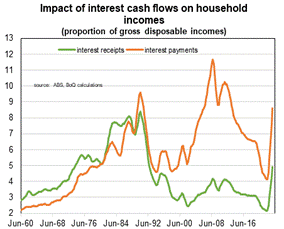
Impact of interest cash flows on household incomes
The proportion of gross disposable incomes show that higher interest rates are negative for some househld incomes.
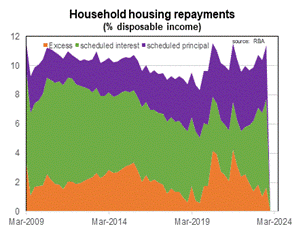
Household housing repayments against disposable income
Houseing repayments are at an elevated level relative to incomes.
Household incomes are falling victim to ‘bracket creep’
Tax payments have been a significant drag on household disposable incomes over the past couple of years. This has partly been for good reasons (very strong full-time jobs growth with workers enjoying the highest pay increases in 15 years). But the wage rises mean more households have drifted into higher tax brackets (what we call ‘bracket creep’). Tax payments in recent years have also increased due to the end of the low and middle income tax offset.
The negative drag from tax will be significantly reduced in the new financial year with the implementation of the stage three of the income tax cuts. The recent changes by the government will not alter the total change of tax cuts. It has changed the distribution with a far higher proportion of the cuts going to lower- and middle-income households. And that will likely mean stronger growth of household spending (and a lower level of saving) than would have occurred under the initial tax cut plan.
Inflation has halved, with further declines predicted
The other big positive for households is the moderation of inflation. The RBA calculations had inflation in 2023 being the biggest drag on household disposable incomes in at least 30 years. Inflation has halved from its peak, with further declines almost certain. We probably are close to the peak of wages growth. But it looks very likely that aggregate wages growth in 2024 will exceed the inflation rate (in the jargon, there will be positive real wages growth).
The bottom line
Economic growth has slowed notably in 2023-24. This has mainly been a result of households having less spare income because of high inflation, rising interest payments, and increasing tax payments. But households should have more spare income in the second half of the year as taxes are cut and inflation moderates. More disposable income should mean more spending.
One big unknown is how much of this additional income households will end up spending. The household saving ratio declined notably over the past year as consumers had to use more of their income to make ends meet. The risk is that households might take the opportunity to bump up their saving again as they receive additional income. Indeed, I would be surprised if there is not some rise in household saving. But the change in the composition of the tax cuts and the rise in house prices is likely to mitigate how much saving increases.
This should mean that the Australian economy will finish the year in better shape than it started. But at this stage I doubt that the growth that we will see by year-end will be strong enough to make households and businesses feel we are in a strong economy. We will see.
We really do live in interesting times.
Regards,
Peter Munckton
BOQ Chief Economist.
You might also like
NOT INVESTMENT RESEARCH
This presentation was prepared by Bank of Queensland Limited ABN 32 009 656 740 Australian Credit Licence Number 244616 (Bank).
No Reliance
This presentation is not investment research and does not purport to make any recommendations. This report is for informational purposes only and is not to be relied upon for investment purposes. You should seek independent advice from a qualified professional on these matters.
This presentation has been prepared without considering your objectives, financial situation, knowledge, experience or needs. The content of this presentation is not to be construed as an act of solicitation, or an offer to buy or sell financial products. To the extent that you choose to make any investment decision after having read this report, you should consider the appropriateness and suitability to your own objectives and obtain independent professional advice about your particular circumstances.
The Bank makes no representations or warranties about the accuracy or completeness of the content contained in this presentation. Any opinions, conclusions or recommendations made in this report are subject to change without notice, and may differ to the opinions, conclusions or recommendation expressed elsewhere by the Bank. The Bank is under no obligation to update, keep current, the information contained in the report.
Forward-Looking Statements
This presentation may contain forward-looking statements about market conditions. These forward-looking statements may be identified using forward-looking terminology, including the terms “believe”, “estimate”, “plan”, “target”, “project”, “anticipate”, “expect”, “intend”, “likely”, “may”, “will”, “could” or “should” or, in each case, their negative or other variations or other similar expressions, or by discussions of future events.
Readers should not place undue reliance on any forward-looking statements. To the maximum extent permitted by law, responsibility for the accuracy or completeness of any forward-looking statements, whether because of new information, future events, or results or otherwise, is disclaimed. BOQ does not undertake to update any forward-looking statements contained in this document, subject to disclosure requirements applicable to it.
Liability
The Bank does not accept any liability for any loss or damage arising out of any error or omission in the information provided or arising out of the use of all or any part of this presentation.