Property market update: 2024 outlook
30 January 2024
Key points
- Dwelling prices grew by around 7 per cent in 2023.
- Throughout Australia in 2023, performance was mixed across housing markets.
- A more modest rise in Australian house prices is expected in 2024.
- Melbourne and Perth are expected to be the best -performing regions for the Australian housing market in 2024.
House price growth was surprisingly strong in 2023
House prices across Australia bounced back in 2023, much to the surprise of most analysts. The annual growth (of around 7 per cent) was near the long-term average.
The rise was broadly the same across houses and units. This followed a couple of years when standalone houses strongly outperformed units in 2020 and 2021, before underperforming in 2022.
House price performance was more mixed across disaggregated market segments. Growth was strong across the Queensland, South and Western Australian housing markets.
Dwelling prices grew robustly in Sydney, less so in regional New South Wales. The increase in Melbourne prices was modest, and negligible in regional Victoria. The Tasmanian, Northern Territory, and Canberra markets were soft.
Dwelling price change{text-center}
(annual % change to Dec 2023){text-center}
Long-term housing market performance
The differences in dwelling price performance between regions can last for longer periods. Over the past five years Melbourne, Perth, and Darwin underperformed in the capital city average, while Adelaide, Canberra, and Hobart did better. Over the past 10 years, Perth and Darwin underperformed, while Sydney and Hobart did best.
The reason for the variation in outcomes is differing economic performance and valuation. The strong performance of Hobart was the result of its low starting house price, relative to that of the mainland capitals, and the decent performance of the Hobart economy.
The underperformance of the Perth and Darwin markets was due to the end of the mining boom, when both markets performed particularly well.
The difference in house price performance between capital cities was only modest over a 20-year horizon, with Hobart the clear winner again. The evenness of the performance over a longer timeframe may reflect that fiscal and monetary policy have broadly the same impact across the states.
Inter-state population movements are driven by performance of regional jobs markets and differences in housing affordability. The result is that over a long period these factors have tended to even up house price outcomes.
Annualised price growth by capital city
The relatively consistent performance of house prices across capital cities has been a feature of the past 40 years. The proportionate difference between Sydney and other capital city house prices has tended to fluctuate around a stable average, with cyclical movements reflecting changes in regional economic and house price valuation differences.
The performance of the Perth and Darwin markets does differ to that of the other capital cities reflecting the greater distance of those two capitals from the major population centres on the East Coast, as well as the greater importance of the mining industry in the Western Australian and the Northern Territory economies.
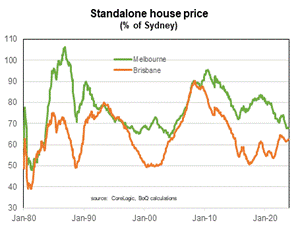
House price relationships between capital cities have been broadly stable over the long-term.
The housing cycle is very different in Perth and Darwin.
Differences between house price performance over time periods is also evident at a more local level.
Over the past five years, the average price rise in the LGAs in outer areas of the major capital cities was greater than for LGAs closer to the city centres. Affordability was a factor, as well as the shift to working from home (WFH) – creating the need for more space at home and the lower cost of commuting. That outperformance disappeared when measured over a 10-year period in Sydney, and over a 20-year timeframe in both Sydney and Brisbane (the outer suburban areas outperformed in Melbourne across time periods).
Why has there historically been less difference in performance between inner and outer regional LGAs in Sydney compared with the other major East Coast capitals? I suspect that it is down to topography; with Sydney being surrounded by water and mountains, making the commute from outer regions more difficult.
It is possible that the WFH shift, and affordability worries could result in a sustained outperformance by the Sydney outer regional LGAs. Time will tell.
Average annual standalone house price change across capital cities in Australia's east coast
This pattern of house price divergences minimising over time is also clear when examining the standard deviation of annual house price growth – or the typical difference between house price performances – within regions.
Given the similarity of economics within a region, house price performance is then largely driven by affordability. The lower standard deviation within inner city LGAs reflects the greater similarity of the economies of city LGAs relative to the economies of the LGAs of regional areas.
Standard deviation of annual house price growth
What does this mean for the Australian property market?
In the short term, there can be big differences in price performance between different housing regions. The problem though is picking the time of these moves. Most economists thought that house prices would decline in 2023. Instead they rose by 7 per cent.
Over long-term horizons (greater than 10 years), differences in price performance between regions has historically been more modest. In some circumstances differences can emerge if there are longer-term structural changes taking place, like the affordability differences between city and regional LGAs in Melbourne, for example.
Forecast for house prices for 2024 and for 2025
Average house price growth is likely to be lower Australia-wide in 2024 than it was in 2023. Household disposable income growth will be constrained for much of this year. Partly this will reflect further weakening of the jobs market. And I am not forecasting interest rate reductions until the end of this year.
The lack of new supply puts a floor as to how far house price growth can slow (at least without substantial changes in interest rates or the unemployment rate). If interest rate cuts take place earlier (and are more aggressive) than I currently anticipate, then house price growth will be stronger. Stronger house price growth is likely in 2025 as interest rates are reduced and the economic outlook improves.
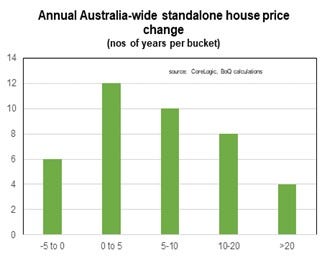
The most common annual percentage change in house prices is 0-5 per cent.
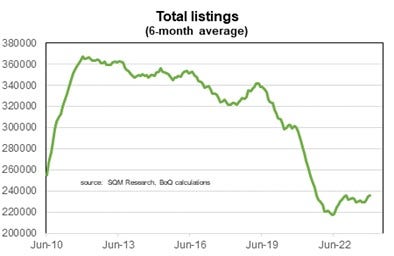
Listing numbers have remained low since 2019.
I expect that biggest rise in standalone house prices in 2024 will be in Melbourne and Perth, the two cities that I think currently provide best value (such as comparing rental yields with the level of long-term interest rates).
Melbourne price performance last year was modest by capital city standards. The Perth market is only now recovering from the fallout from the end of the mining boom. Perth housing prices will also be supported by constrained new housing supply, as well as WA having the second lowest state unemployment rate.
The Sydney housing looks the most expensive and so is likely to underperform. Adelaide and Brisbane prices have moved substantially over the past couple of years, and I would expect price movements in those two cities to be more in line with the national average this year. The Hobart, Canberra and Darwin markets have been soft over the past couple of years. I look for those three markets to do relatively better in 2024, although I think that another year of below average growth is likely.
Annual percentage change in standalone Australian house prices
We do really live in interesting times.
Regards,
Peter Munckton
BOQ Chief Economist.
You might also like


NOT INVESTMENT RESEARCH
This presentation was prepared by Bank of Queensland Limited ABN 32 009 656 740 Australian Credit Licence Number 244616 (Bank).
No Reliance
This presentation is not investment research and does not purport to make any recommendations. This report is for informational purposes only and is not to be relied upon for investment purposes. You should seek independent advice from a qualified professional on these matters.
This presentation has been prepared without considering your objectives, financial situation, knowledge, experience or needs. The content of this presentation is not to be construed as an act of solicitation, or an offer to buy or sell financial products. To the extent that you choose to make any investment decision after having read this report, you should consider the appropriateness and suitability to your own objectives and obtain independent professional advice about your particular circumstances.
The Bank makes no representations or warranties about the accuracy or completeness of the content contained in this presentation. Any opinions, conclusions or recommendations made in this report are subject to change without notice, and may differ to the opinions, conclusions or recommendation expressed elsewhere by the Bank. The Bank is under no obligation to update, keep current, the information contained in the report.
Forward-Looking Statements
This presentation may contain forward-looking statements about market conditions. These forward-looking statements may be identified using forward-looking terminology, including the terms “believe”, “estimate”, “plan”, “target”, “project”, “anticipate”, “expect”, “intend”, “likely”, “may”, “will”, “could” or “should” or, in each case, their negative or other variations or other similar expressions, or by discussions of future events.
Readers should not place undue reliance on any forward-looking statements. To the maximum extent permitted by law, responsibility for the accuracy or completeness of any forward-looking statements, whether because of new information, future events, or results or otherwise, is disclaimed. BOQ does not undertake to update any forward-looking statements contained in this document, subject to disclosure requirements applicable to it.
Liability
The Bank does not accept any liability for any loss or damage arising out of any error or omission in the information provided or arising out of the use of all or any part of this presentation.